

The International Development and Agricultural Economics (IDAE) master's study programme provides students with a strong foundation in agricultural economics, international development, and sustainable food systems, preparing them to address contemporary challenges in agriculture, rural development, agroecology and global food security.
Combining economic and behavioural principles and theories, the programme explores contemporary challenges in agricultural production, agri-food value chains, poverty reduction, climate change adaptation, natural resource management, gender empowerment and agricultural policy, with a particular focus on tropical and developing regions.
The programme is designed to equip students with the analytical, research, and decision-making skills needed to understand and address complex development challenges in agriculture and rural areas.
Two-year study programme with possible Double-Degree form in Thailand
The IDAE study programme is a two-year programme consisting of four semesters. The outline of theoretical, supportive, obligatory, elective and thesis-related courses is available here:
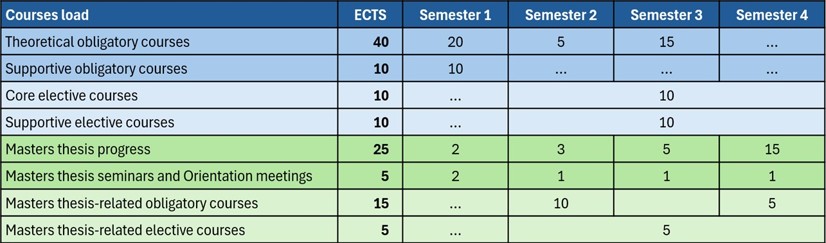
As we place a strong emphasis on the final thesis, most theoretical and mandatory supporting courses are scheduled for the first semester. This provides students with great flexibility to select elective courses, schedule internships, Erasmus, etc. The last semester includes no obligatory courses, so students can focus on their thesis, take electives, or pursue an internship.
Check the Documents section for the full list of courses from the “IDAE Course Structure” PDF document.
One of the important options of the IDEA study programme is the possibility to study in the Double-Degree form in cooperation with Prince of Songkla University in Thailand. For more information on the Double-Degree form, click the following link.
Master’s thesis
Research and thesis preparation are central parts of the programme. The master's thesis, together with thesis-related courses, accounts for 50 of the 120 ECTS credits, reflecting the programme's strong research orientation.
To support the successful completion of their thesis, students participate in a series of research seminars that introduce key principles of scientific inquiry in agricultural economics and international development.
These seminars help students develop research proposals, strengthen analytical and methodological skills, and improve their ability to communicate and defend research findings to academic and professional audiences as well as to local communities, practitioners, and other stakeholders.
Students select their thesis topic during the first semester and join a research team led by an academic supervisor at the faculty.
Through active participation in ongoing research and innovation projects, students gain valuable hands-on experience and practical research skills.
Additional opportunities include:
- Research and professional internships.
- Collaboration with partner institutions.
- Participation in international conferences and workshops.
- Field research in tropical and developing regions.
These experiences enhance both academic development and career readiness while providing students with valuable international exposure.
Master's thesis topics address challenges relevant to both tropical and developing regions as well as Europe, enabling students to apply theoretical knowledge and analytical methods across diverse socio-economic and environmental contexts:
- Community development and empowerment
- Natural resource management
- Consumer studies
- Landscape perception and sustainable rural development
- Farm succession
- Social and societal transformation
- Formulation of people-centred policies at local, regional and national levels
Why Choose This Programme?
Personalised Learning Environment
Study in small groups of around 25 students, which enables a very personal approach.
Benefit from close interaction with academic staff and an individual approach to learning and supervision.
Strong Research Focus
Research and thesis work account for nearly half of the programme's credits.
Develop advanced skills in research design, data analysis, critical thinking, and scientific communication.
High-Quality Teaching
Learn from experienced academics and researchers with expertise in agricultural economics, international development, and tropical agriculture.
Combine theoretical knowledge with practical applications and case studies from around the world.
International Experience
Chance to spend 6-12 months at a partner university through the Erasmus programme.
Take advantage of the Double-Degree from of IDEA study programme and use the opportunity with Prince of Songkla University in Thailand.
Build an international professional and academic network.
Real-World Development Challenges
Engage with research and development activities in tropical and developing regions.
Apply economic and analytical approaches to agriculture, food systems, rural livelihoods, and sustainable development.
Excellent Career Prospects
Graduates develop a highly sought-after combination of economic expertise, research competence, quantitative analysis skills, problem-solving abilities, intercultural experience, and professional communication skills.
These competencies prepare them for careers in:
These competencies prepare them for careers in:
- Private companies, start-ups, and entrepreneurial ventures
- International development organisations
- Government institutions and public administration
- Agricultural and rural development projects
- Research institutions and universities
- Agribusiness and consultancy organisations
- International agencies and non-governmental organisations
The programme prepares graduates to become analytical, globally minded professionals capable of designing solutions to complex agricultural, environmental, and development challenges in an increasingly interconnected world.
Graduate Profile
Graduates combine expertise in agricultural economics, behavioural studies, and applied research, enabling them to work across academia, policy, development practice, and the private sector.
By combining strong theoretical foundations with practical research experience in diverse cultural contexts, they develop the analytical, communication, and problem-solving skills required to succeed in an increasingly globalised and dynamic labour market.
Admission Requirements
Admission requirements follow the regulations of the Faculty of Tropical AgriSciences and are identical to those of the International Development and Agricultural Economics programme.
The admission plan for the master’s study programmes is available on our faculty webpage here.
Tuition Fees
Tuition fees are identical to those for other master's programmes offered by the Faculty of Tropical AgriSciences:
8,000 CZK per academic year (EU applicants) and 25,000 CZK per academic year (non-EU applicants)
Contact Information
Study programme guarantee:
Vladimír Verner
Responsible for communicating the scope of the study programme and research priorities
Contact Person for Double-Degree form:
Petra Chaloupková
Responsible for communicating the Double-Degree form of this study programme
Please, use the following email address for all technical and/or administrative queries for the admission process: admission_ftz@ftz.czu.cz.
Programme guarantee short bio:
Vladimír Verner is Professor (Associate) at the Faculty of Tropical AgriSciences, Czech University of Life Sciences Prague, and Leader of the TRACE Research Group (Tropical Farming Systems & Environmental Economics).
His research and teaching focus on agricultural economics, sustainable farming systems, rural development, and poverty alleviation, with expertise in tropical and developing regions.
Drawing on extensive international research experience and collaboration with organisations such as FAO, UNDP, IFAD, and the CGIAR, he combines his academic expertise with practical insights into contemporary challenges in agriculture, food security, empowerment, climate change and natural resource management.


