APPLY HERE

Behind the Beans: Exploring the Secrets of Colombian Coffee

One year ago, I was offered an internship at the National Coffee Research Centre of Colombia (Cenicafé). Cenicafé has bred new coffee varieties resistant to diseases, so it seemed relevant to calculate these thermal and physical properties because the country is rapidly changing and renewing the coffee crops towards disease-resistant types.

The thermal and physical properties directly affect the drying process due to the mass transfer between the grain and the drying air, where the moisture (water) is removed from the grain until it is safe against developing moulds, microorganisms, and mycotoxins. The better the physical and thermal properties, the better the moisture removal can happen, not only safekeeping the grain but also improving the final quality of the coffee.

Considering that my dissertation thesis focused on the design of a hybrid solar dryer for coffee, and the country is moving to these new varieties, plus their properties were still unknown, it felt like an excellent opportunity to use the internship to calculate them, not only to update the literature but also to use these new data to perform an accurate design of the dryer I intended to build.

The visit was carried out last year between April and May. This time of the year is significant because the first harvest happens in these months (on the other hand, it is pretty rainy). We evaluated two different varieties, var. Cenicafé 1 and var. Castillo, both Coffea arabica L. More than two thousand experiments were carried out to calculate the following properties of parchment coffee at 5 different moisture contents (53, 42, 32, 22, 11% (wb)):

  • Grain mass.

  • Orthogonal dimensions (length, width and thickness).

  • Kernel density.

  • Bulk density.

  • Superficial area.

  • Bulk-specific heat capacity.

  • Bulk-thermal conductivity.

New techniques were used to calculate these properties to ensure accuracy, machinery was designed and built, and electronic circuits and apparatuses as well. The lab work started intensively; nevertheless, all the experiments were done without problems. The data set was massive once the month was over, and the statistical analyses began along with the writing. After a couple of months, the manuscript was ready to be sent, and by January 2023, the results were successfully published.

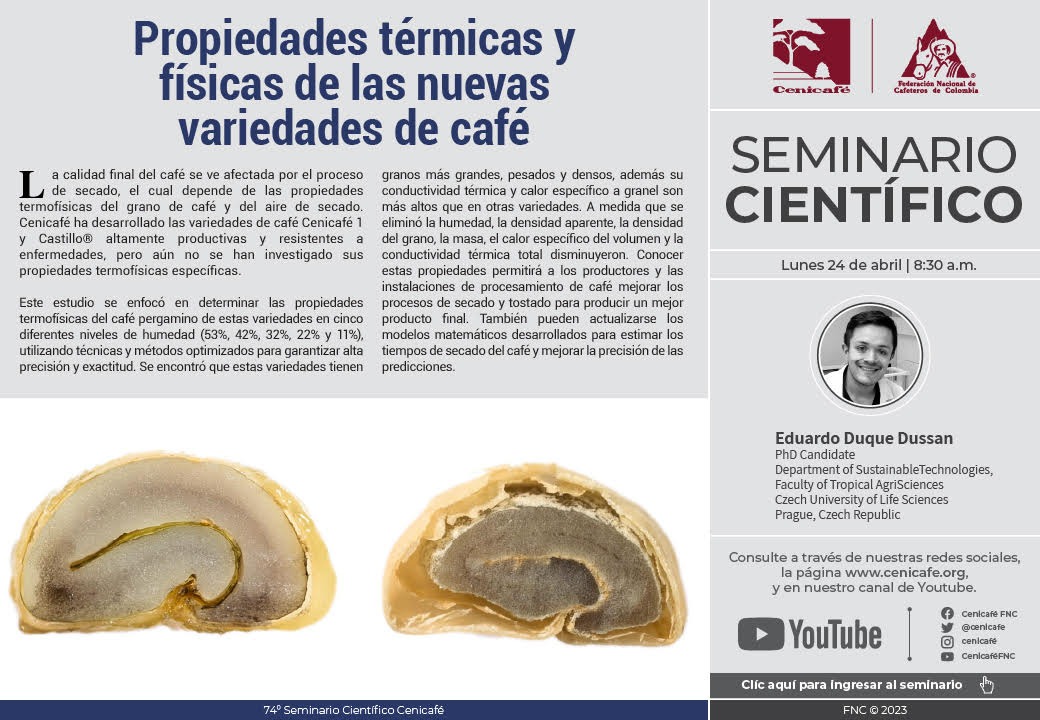
The National Coffee Research Centre of Colombia is a place of research and scientific excellence, that is why, for the last 7 years, a set of scientific seminars have been carried out one morning per month, where different researchers from all around Colombia and the world are invited to speak about a relevant topic that could be useful for Cenicafé's staff.

That is why I was invited to speak at the seminar to share the research results with all of Cenicafe's team and invited guests.

The talk was a 45-minute speech (presentation), followed by a 15-minute slot for questions and discussion. In general conclusion, the thermal and physical properties of the new Colombian coffee varieties are better than those described by the old ones.

It was retributing to see the impact of the research; I always saw it from the engineering perspective. Still, it also affected the quality, plant physiology, genetic improvement and other departments. Even by sharing the methods, different questions came out to replicate or adapt the techniques I used in new research evaluating several scenarios (even entomology).

The experience was great and quite challenging! If you are interested in listening to the seminar, follow the link or watch it below.


Hope you like it!

Eduardo Duque Dussan 

Další články v rubrice

English ☰ Menu
Cookie settings

We use cookies and similar technologies on the websites of the Czech University of Life Sciences Prague (under the domain czu.cz) to ensure the proper functioning of the website. With your consent, we also use them to measure traffic (Google Analytics 4), analyze website performance, and for marketing purposes (Meta, Sklik, Google Ads), including displaying embedded videos (YouTube). Information about how you use our websites may be shared with our partners in the fields of analytics, social media, and online advertising. Essential cookies are always active. You can change or revoke your cookie preferences and consent at any time in "Cookie Settings."