

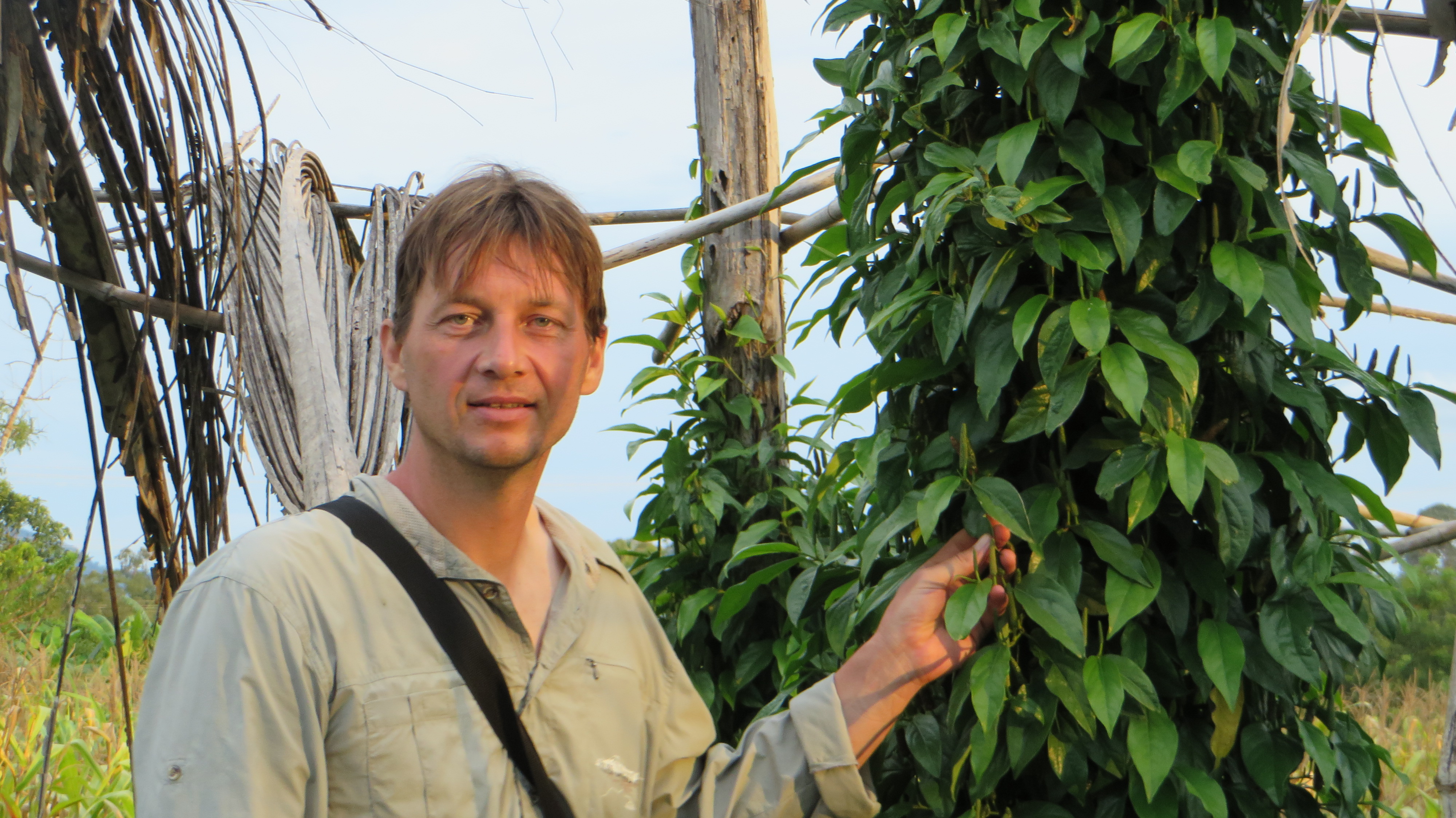
Why are tropical plants so interesting to scientists? How can their biologically active compounds contribute to the development of new medicines or more sustainable food preservation? And what does conducting research directly in tropical regions involve? Prof. Ing. Ladislav Kokoška, Ph.D., an ethnobotanist and ethnopharmacologist at the Faculty of Tropical AgriSciences, Czech University of Life Sciences Prague, discusses these questions in an interview with TÉMA magazine.
In 2024, Prof. Ladislav Kokoška received an award from the renowned ScholarGPS platform for his scientific contribution and publication record. His research team has been studying the biological effects and chemical composition of compounds found in tropical plants, many of which have traditionally been used in local medicine. Their work combines field research in Southeast Asia and the Pacific with laboratory research in Prague.
Why tropical plants?
Tropical ecosystems are characterised by exceptionally high biodiversity. Although tropical rainforests cover only around six to seven per cent of the Earth's land surface, they are home to more than half of all known plant and animal species.
High biodiversity also means intense competition between organisms. Plants have to cope with strong pressure from pests, diseases and other environmental factors. Over the course of evolution, they have therefore developed a range of defence mechanisms, including the production of so-called secondary metabolites.
These compounds are a major focus of ethnobotanical and ethnopharmacological research. Some have biological effects against bacteria and fungi, while others may have anti-inflammatory properties or affect tumour cells. According to Prof. Kokoška, tropical plants may therefore represent an important source of compounds with potential for the development of new medicines.
A European centre for ethnobotanical research
Research into tropical plants does not have to take place exclusively in the tropics. According to Prof. Kokoška, the Faculty of Tropical AgriSciences is home to a research group that ranks among the important centres of ethnobotanical research in Europe.
“We are, in a way, a European centre for ethnobotanical research, and our results attract attention,” Prof. Kokoška says in the interview with TÉMA.
The international character of the research is also reflected in the strong presence of international students. With the exception of one bachelor's programme, the study programmes at FTZ are taught in English, creating a natural environment for international cooperation and the exchange of knowledge and experience.
From traditional knowledge to laboratory research
Research often begins directly in the field. Prof. Kokoška's teams collaborate with local universities, research institutions and communities. They gather information about how particular plants are used in everyday life and traditional medicine, and then identify selected species and collect samples for further research.
Respect for local rules, traditions and international standards is an essential part of this work. Researchers therefore do not operate in isolation but in cooperation with local institutions. Teaching at FTZ also covers international rules and conventions governing access to genetic resources and traditional knowledge.
Prof. Kokoška and his colleagues have long focused primarily on Southeast Asia and the Pacific. Their research expeditions have taken them to Cambodia, the Philippines, Thailand, Laos, Samoa, Vanuatu and Fiji. The team is now also preparing research in India, where it plans to cooperate with a local university and visit a clinic specialising in Ayurveda.
What can a tropical plant offer modern medicine?
The history of pharmacology shows that natural compounds can be an important source of medicines. For example, vincristine and vinblastine, which are used to treat certain forms of cancer and leukaemia, were discovered in the 1960s in Madagascar. Both compounds were identified in the rosy periwinkle, a plant that was originally studied because of its traditional use in the treatment of diabetes.
There are many other examples. Some tropical plants provide compounds already used in medicine, while others may prove valuable in completely different fields. At the same time, Prof. Kokoška stresses that there is no reason to expect the discovery of a universal cure, for example for cancer. Different types of cancer have very different characteristics, and no single universal remedy exists.
The aim of the research is therefore to gradually discover and characterise individual compounds and investigate their potential biological effects.
Research with potential beyond medicine
One of the key areas of research pursued by Prof. Kokoška's team is antimicrobial compounds in the volatile, or gaseous, phase. Their properties could potentially be used, for example, in inhalation therapy for certain infectious diseases. However, their potential extends beyond healthcare.
One possible application is in food technology. Researchers are exploring the principle of smart packaging, in which antimicrobial compounds could create an effective atmosphere around food. This could be particularly useful for foods with complex surfaces, such as strawberries, raspberries and blackberries, which are susceptible to rapid fungal growth.
The team has also developed several unique methods for testing antimicrobial compounds in the gaseous phase. According to Prof. Kokoška, patent applications for these methods have been filed in the European Union, the United States and Canada.
When research takes place in the field
The work of an ethnobotanist is not limited to the laboratory. Research expeditions to tropical regions also involve encounters with local cultures, traditional practices and, occasionally, unexpected situations.
In Vanuatu, for example, Prof. Kokoška tasted the traditional drink kava kava, made from the root of the kava plant. In the local culture, serving kava is part of welcoming guests, and refusing it may be considered impolite.
In the Philippines, the researchers encountered the traditional practice of chewing betel and, during their fieldwork, also tasted local specialities including balut. Tropical field research can also bring less pleasant experiences. Prof. Kokoška contracted dengue fever during fieldwork in Cambodia, while members of his team have also faced injuries and other health complications.
Despite these challenges, direct field experience is an essential part of this type of research. It allows scientists to study not only the plants themselves, but also the cultural and social context in which they have been used for generations.
From tropical forests to research laboratories in Prague
Prof. Kokoška's research connects several worlds: the traditional knowledge of local communities, the biology and chemistry of tropical plants, field research in different parts of the world and modern laboratory methods.
This interdisciplinary approach is one of the characteristic features of research at the Faculty of Tropical AgriSciences. Tropical regions are not viewed merely as distant and exotic environments, but as places where research can address questions with relevance far beyond their borders – from biodiversity and traditional knowledge to new possibilities in medicine, food technology and other fields.
Read the full interview with Prof. Ladislav Kokoška in TÉMA magazine.