
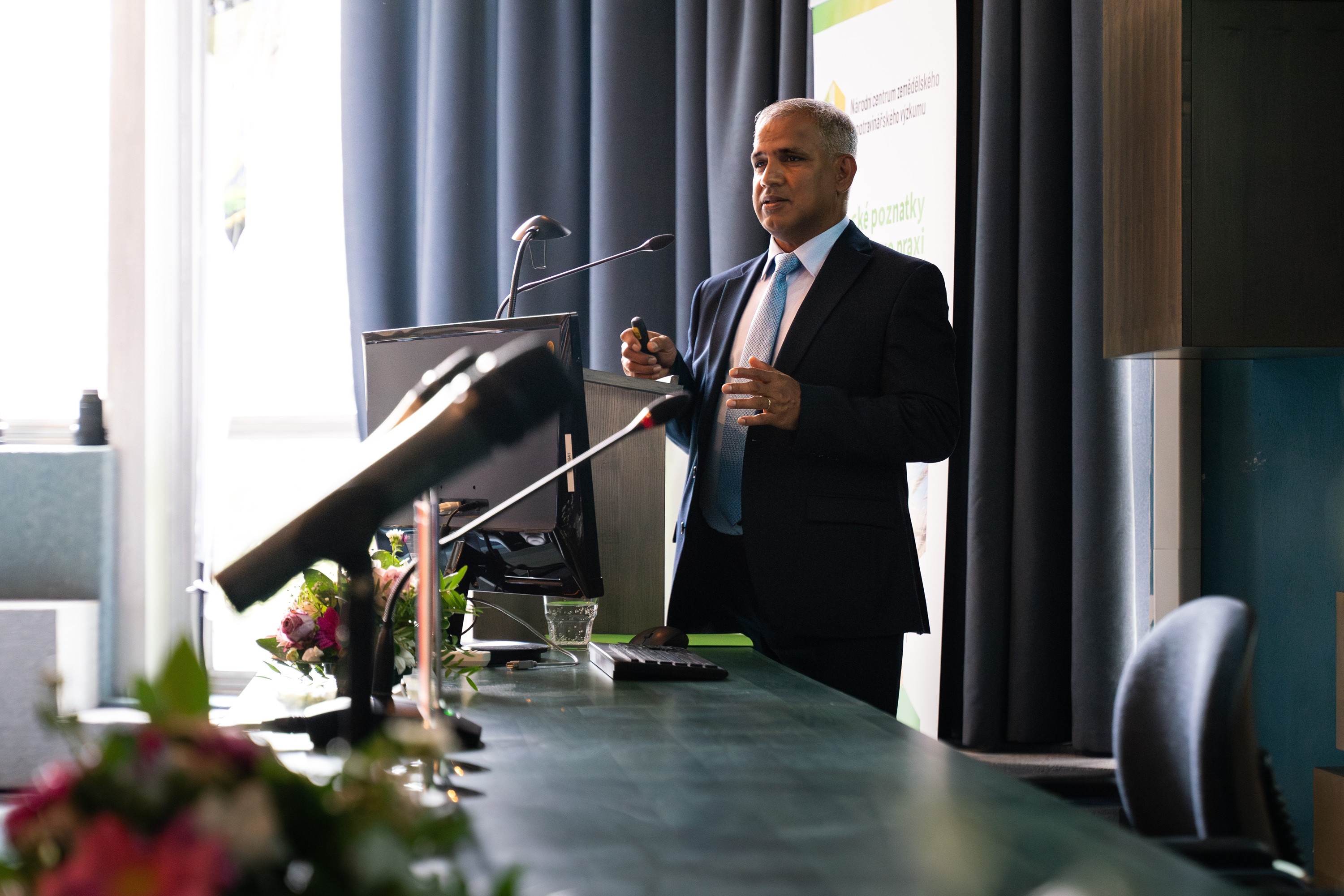
Jiban Kumar, Ph.D., an alumnus of the Faculty of Tropical AgriSciences (FTZ), leads the Czech Agrifood Research Center – the largest institution in the Czech Republic dedicated to research in agriculture and food sciences.
Name: Jiban Kumar, Ph.D.
Position: Director, Czech Agrifood Research Center (CARC)
Degree programme at FTZ (formerly ITSZ): Plant Production, specialising in Genetics and Plant Breeding (Master’s)
His professional journey illustrates how rigorous scientific training, international experience, and personal commitment can be transformed into strategic leadership. Today, he serves both as Director and as an active researcher. He consistently fosters collaboration between research institutes and universities and has made a substantial contribution to the advancement of scientific knowledge and technological innovation.
In this interview, Jiban Kumar, Ph.D., reflects on his early studies, the international environment of the faculty, and the mentors who shaped him. He outlines the path from his first research experiences to his current leadership role, sharing his views on science, management, and education. His insights are inspirational not only for current students, but for anyone considering a career in research.
Could you introduce your work?
I serve as Director of the Czech Agrifood Research Center (CARC), the largest institution of its kind within the agricultural sector. The Centre was established through the merger of three research institutes and now covers the full spectrum of topics – from plant genetic resources and crop protection, through agricultural machinery and technology, to food science and technology.
My role encompasses the conception and implementation of the Centre’s development strategy, organisational leadership, investment and infrastructure planning, and the cultivation of national and international partnerships, including cooperation with universities and industry. Alongside these responsibilities, I remain actively engaged in my research group. Scientific work continues to motivate and fulfil me – it offers direct contact with new challenges and knowledge, with students and colleagues, and preserves a strong link between institutional leadership and practical research.
What led you into a leadership position?
From a young age, I naturally gravitated towards organising activities and leading groups. I was strongly influenced by my parents and their values: responsibility, diligence, and a profound respect for education. My international experience was equally formative. I had the opportunity to observe how excellent institutions operate – for example, at the University of Toronto – and to appreciate the crucial role of effective leadership. These values and experiences continue to guide me, motivating me to move CARC forward and to uphold high professional and ethical standards. I believe leadership is meaningful only when it creates the conditions for people to grow, supports their talents, and ensures that science and innovation generate new knowledge that truly benefits society.
How did you come to work in the Czech Republic?
In 1986, I came from Bangladesh, where I was born, to Czechoslovakia on a scholarship to study a Master’s degree at the then Institute of Tropical and Subtropical Agriculture (ITSZ). I later continued with doctoral studies. During my PhD at the Faculty of Agrobiology, Food and Natural Resources (FAPPZ), it became clear that research was my vocation. After my PhD defence, a member of the examination committee offered me a position immediately – so I did not really search for work; it found me. Subsequently, I received offers from abroad, including from INRA in France. Ultimately, I chose to remain in the Czech Republic, where new opportunities gradually emerged and where I could continue both my scientific and academic career.
What do you enjoy most about your work?
My greatest satisfaction stems from the combination of institutional leadership and research. I enjoy conceptual thinking, strategic planning, and being in a position to influence the development of the organisation. At the same time, I am deeply engaged in research – in the questions we address, in working with young scientists and students, and in the joy of achieving new results. It is demanding, but highly meaningful, and it continues to motivate me.
How do you support your team?
I support my team by example, open communication, and clearly articulated expectations. I work to create excellent conditions for their work, ensure access to modern technologies, and encourage ambition. I expect a great deal from myself and from my colleagues, yet I build on trust and fairness – because only in such an environment can people grow and deliver high-quality results.
What are your plans for the future?
My ambition is for CARC to grow both scientifically and societally and to strengthen its national and international standing – to be recognised among the leading research institutions in the world. A key priority for me is deeper collaboration with universities, particularly the joint supervision of doctoral candidates and shared research projects. The aim is to attract talented young researchers, connect education with practice, and create an environment comparable to international postgraduate centres. I am inspired by successful models in France and the United States, where such cooperation has long been established.
What did you enjoy most about studying at our faculty?
I most appreciated the international environment and campus atmosphere. I had the opportunity to meet classmates from around the world – from Africa, Asia, Latin America, and Europe – to learn about their cultures and share student life together.
As a child, I read in a textbook that the national dish in some African countries is fufu, yet nobody could tell me what it really was. Only here, with my African classmates, did I participate in preparing it and taste it – fulfilling a childhood curiosity and opening a small window into the wider world.
At the same time, I had many Czech friends who enriched me culturally and personally, and helped me understand the Czech environment, which later became my home. This combination of a Czech setting and an international community was enormously enriching – both personally and professionally. I am convinced that without this faculty, I would not have experienced such a diverse cultural and human dimension.
Who influenced you most during your studies?
All my teachers and friends influenced me, and it is difficult to name only a few. However, I was particularly inspired by Professor Táborský, Professor Zelený, Professor Valíček, and Professor Bláha. They belonged to the “old school” of academics – strong expertise, demanding standards, yet also personally very friendly and fair. Their approach continues to influence me to this day.
What advice would you give current students?
Study with an open mind. Be curious and engage with your studies with genuine interest. Do not be afraid to have your own vision – even a simple one, but sincere. Remain natural and free-thinking, give space to healthy curiosity, and strive to be useful to society and to those around you. Be demanding of yourselves and work with humility, modesty, and, above all, enthusiasm. Do not force results at any cost. If you do things with passion, conviction, and perseverance, the results will eventually follow.